Secondary Sources
- Doyle, Sean M., ed. Light of the East: The Calcutta School of Jesuit Indology on Hindu Advaita Non-Dualism. Boston: Institute of Jesuit Sources, Boston College, 2026.
Secondary Sources
Sean Doyle was kind enough to send me a copy of his latest book: Light of the East. The Calcutta School of Jesuit Indology on Hindu Advaita Non-Dualism, ed. Sean M. Doyle. Boston: Institute of Jesuit Sources, Boston College, 2026.
A handsome book, and one that is a great addition to the literature about the encounter between Christianity and Hinduism in India.
The Calcutta School of Indology is not very well known, though the adepts certainly know about it. It was mentioned in Doyle's own earlier book, the one resulting from his doctoral research on Pierre Johanns, himself one of the leading figures in the School (Sean Doyle, Synthesizing the Vedanta: The Theology of Pierre Johanns, S.J. Oxford: Peter Lang, 2006).
The Calcutta School of Indology includes Pierre Johanns, SJ (1882–1955), Georges Dandoy, SJ (1882–1962), but also William Wallace, SJ and Michel Ledrus, SJ.
Doyle's book provides an introduction to the School, summaries of the lives and insights of its members, and selections from their writings, all pertaining to their encounter with Advaita Vedanta. An appendix of supplementary materials also includes obituaries of Brahmobandhav Upadhyaya (who is in many ways the forerunner of the School), Animananda, and William Wallace (perhaps the "pioneer-founder" of the School), as well as texts of the last two.
Richard De Smet gets a few mentions, but is nowhere prominent. The question arises: could he be considered part of the School? The great members were certainly among his outstanding teachers in Kurseong, and he deliberately puts himself in their wake. Perhaps a son of the School, if not a full-fledged member...
Mariano Saldanha's full name was "Mariano José Luis de Gonzaga de Saldanha" according to Mousinho de Ataide, in "Dr. Mariano de Saldanha: Researcher, Sanskritologist and Konkani Scholar. My Tribute on the 50th anniversary of his death," Renewal Novsornni Renovacão LXIV/2 (16-31 January 2026) 12-13.
Yesterday, visiting the Xavier Historical Centre, Porvorim, I browsed through Mariano Saldanha's very interesting account of Christian puranic literature. Some points I found useful:
1. His list of Christian puranas - at least 8.
2. His mention of a Devanagari script MS of the Khristapurana in the Bibliothek National, Vienna. (M. Saldanha p. 8)
3. That this literature is largely unknown and forgotten in Goa - the reasons he gives are that, with education, people were unable to access the Marathi language Puranas. The exceptions in Portuguese Goa are the fishing communities of Tiracol, Chapora, Morgim and Assanora:
"constituindo o único deleite literário de alguns rendeiros e pescadores de nossas remotas aldeias, como Tiracol, Chaporá, Morgim e Assonorá," (M. Saldanha p. 5)
4. He takes issue with Abbott, who considered the Marsden Devanagari MSS the originals. [However, the issue is still debatable, according to me.] Abbott does, however, reveal an insufficient knowledge of the Stephens' KP, as when he says that no one even suspected the existence of a Devanagari MS. J.L. Saldanha clearly mentions that he had one such MS at his disposal.
"The discovery I made that these two parts (do Purana de Londres) were the Devanagary Original of the Christian Purana of T. Stevens, edited by J.L. Saldanha and published in Mangalore in 1907, was a complete surprise, for I believe it has not even been suspected that such a Devanagary original existed. » (Abbott, at M. Saldanha p. 8)
5. M. Saldanha considers the Mangalore edition of J.L. Saldanha as standard.
6. Cunha Rivara did not know any Indian languages. He considered the KP as a work in Konkani, which is clearly contradicted by what Stephens himself writes.
Jason Pinto has found one more MS of the KP, in the Konkani Dept. Library of St Aloysius College Mangalore.
[Manuscript.] First page:] Bhavarthiyam Cristavam samantansi Padri Thomas Estevam vdannd ayvxe bhovxe va Paramesvuarachy Krupa bhaqhitaye.

[Cover page, obviously a later addition:] Krista Puran by Fr. Thomas Steevans. Manuscript – 1614 AD. [The same repeated in Kannada script.]

[Later] In laudem avtoris pelo Frei Gaspar de S. Myquel Religiozo do Patriarca sao Francisco

[Next] Pailempuranna pramesvara svamiya va santa mahantachy stuti anni samagra grahantachy sassari ttica. / Avasuaru 1. [In pencil, this addition:] (Copy) up to ??

Whatsapp correspondence with Jason [12 photos sent]:
[23/01/25, 04:53:50] Jason Pinto: This is from the St Aloysius University, Konkani department library. Not able to exactly locate which year this MSS belongs.
[23/01/25, 08:35:48] ivo coelho: wow, what a find!
[23/01/25, 08:36:16] ivo coelho: the cover page says 1614
[23/01/25, 08:38:11] Jason Pinto: Yes.... But what does that mean?
Original 1614 or copy of KP 1614?
[23/01/25, 08:38:52] ivo coelho: does the library have any indications about provenance: who gave it to them, when, etc.?
[23/01/25, 08:39:02] ivo coelho: how many handwriten pp in total?
[23/01/25, 08:39:12] ivo coelho: could you send me a photo of the last pages?
[23/01/25, 08:39:44] ivo coelho: in itself, 1614 is an odd date, becasue the first print ed was 1616.
[23/01/25, 08:41:06] ivo coelho: but the date 1614 appears in the last Avasvaru , which is 59 in some MSS and 58 in others. anyway, it is always v. 119 - 120. most likely the date is taken from there, in the absence of any evidence to the contrary
[23/01/25, 08:41:29] ivo coelho: you can see that different people have copied it - so many different handwritings
[23/01/25, 08:49:45] Jason Pinto: Ok...will get you the last page
[23/01/25, 08:49:52] Jason Pinto: Yup
[23/01/25, 08:52:13] ivo coelho: If possible, could you tell me what the handwritten note says on the “Pailem Puranna” page?
[23/01/25, 08:52:19] ivo coelho: [Next] Pailempuranna pramesvara svamiya va santa mahantachy stuti anni samagra grahantachy sassari ttica. / Avasuaru 1. [In pencil, this addition:] (Copy) up to ??
[23/01/25, 08:52:26] ivo coelho: (Copy) up to ??
[23/01/25, 08:53:19] ivo coelho: But thanks, and congratulations! you have the researcher’s drive and instinct!
[23/01/25, 08:53:30] ivo coelho: keep looking. don’t forget the Basel Mission!
[23/01/25, 08:53:37] ivo coelho: and the Carmelites.
[23/01/25, 08:53:42] ivo coelho: every bit of evidence helpts
Strangely, Nelson Falcao's Marathi and English translations of the Khristapurana, find no mention in the recent and growing literature on the topic. Perhaps because Falcao chose to publish his two translations "privately" through Kristu Jyoti Publications, and they have not received sufficient critical notice. The Marathi translation did receive book reviews (e.g. in Vidyajyoti and in Divyadaan), but being Marathi, was probably not accessible to most people. The English translation has not, to my knowledge, received enough attention. There are the following mentions of it, but I've not yet found a single real review.
Here is one notice, in Michael Barnes, SJ, Ignatian Spirituality and Interreligious Dialogue: Reading Love's Mystery, Messenger Publications, 2021, p. 274:

Another one: Augustine Kanjamala, The Future of Christian Mission in India: Toward a New Paradigm for the Third Millennium, Pickwick Publications, 2014, p. 12:


In the last few weeks, thanks also to the persistence of Jason Pinto, SDB, we have come to the knowledge of a MS of Thomas Stephens' Khristapurana: The Dussarem Puranna, in the possession of the St Aloysius College Library, Mangalore. Very likely this was one of the MSS used by J.L. Saldanha.

Instead, a great disappointment. We thought we had found the "Falnir Coelho" MS, probably one of those used by J.L. Saldanha (the one borrowed from Julian Coelho?), said to be in the possession of Friar Sidney Mascarenhas, OFM, The Friary, Bengalruru. (Sidney's mother was a Coelho). Joseph Velinkar had reported Ms Kranti K. Farias remark in one of her books about "a very well preserved MS" of the KP in the possession of the "Falnir Coelhos" in Mangalore. Instead, it turned out to be a copy of J.L. Saldanha's 1907 edition, The Christian Puranna.
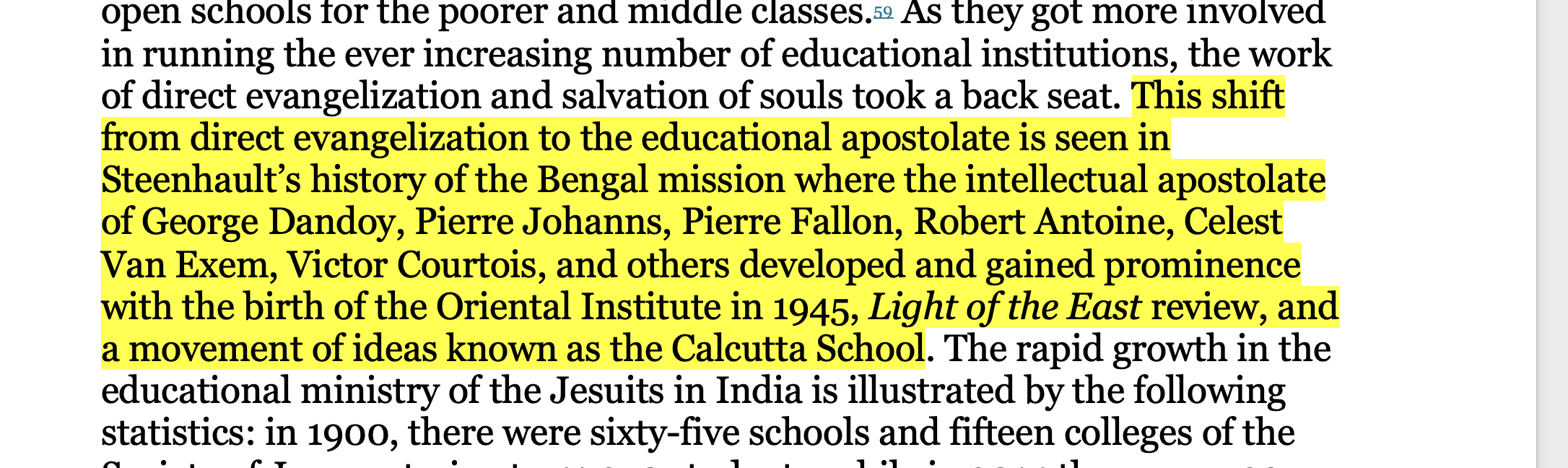
 Cfr. Yves de Steenhault, History of the Jesuits in West Bengal, Part I: 1921–1947 (n.p., n.d).




See the list of KP MSS consulted: the Pilar MS (which she dates at 1609 and calls the earliest extant MS); two copies of the MS at the TSKK; and the "printed edition" (the 3rd, of 1654) held at the Central Library, Panjim. (201n87) Strange that she calls the last "the printed edition", when it is an MS copy of the third edition. The others that she calls MSS are also copies of the printed editions.
She does not mention Nelson Falcao's Marathi and English translations of the KP at all, though she does mention his book (the one coming from his PhD thesis) in the bibliography. Her decision is to make use of the Saldanha edition - perhaps because it is completely in Roman script?
Neither does she mention Tadkodkar.
Her remarks on yema loca and agnicondd are interesting.
She discusses some "confusion" in the economic affairs handled by Stephens in Salcette.
The material she has accessed for the chapter is interesting. It bears comparison with that accessed by Velinkar.
In the Khristapurana, "hell" is translated as "yema loca" but also as "agnicondd" or "agni kund" (see Adi Purana ch. 8, verse 58; A. Chakravarti, The Empire of Apostles 210-11)
Yemaloka is straight enough, but agnikund, according to Chakravarti, is bold: hellfire is now identified with the sacred sacrificial fire.
I remember now the word "yemkondd" in our prayers at home. Here is one occurrence in a common enough prayer, rendered here as "yamkond". A combination of yamaloka and agnikund.
Ie mhojea Jesu amchi patkam amkam bogsi. Yamkondantlia ujiantlem amkam nivar. Samest atmiank, sargar tuji kakutichi adhi garz asleank sargar von tu pavay.
According to Farias Kranti, cited by Velinkar 178, the "Falnir" Coelho family in Mangalore has a well-preserved MS of the Khristapurana. Jason Pinto inquired with the family, they told him they had given the MS to Friar Sidney Mascarenhas (his mother was a Coelho). Unfortunately, what Sidney has is a copy of J.L. Saldanha's 1907 edition, The Christian Puranna. Disappointment!
See Joseph Velinkar, Fr Thomas Stephens: The First Englishman in India (Margao - Goa: CinnamonTeal, 2021).

We are mounting a new search for MSS of the Khristapurana in Mangalore and Goa.
In Mangalore, we need to find out what happened to the 5 MSS used by Joseph L. Saldanha in his 1907 edition, The Christian Puranna (see list below). Any information will be most welcome. Part of the information we need is about the families of the people mentioned below. It is possible that the MSS are still in their possession, or at least that they might know what happened to these. For example, if Mr Marian Saldanha is Prof. Mariano Saldanha of Ucassaim, Goa, we know that his holdings were donated to the Thomas Stephens Konknni Kendra, Porvorim. In that case, perhaps one of the two MSS there is the one used by Joseph L. Saldanha.


It's good to finally have a little biography of the great Fr Thomas Stephens, SJ, author of the Khristapurana. Our gratitude to Fr Joseph Velinkar, SJ for this gift. Our congratulations also to Leonard and Queenie Fernandes of CinnamonTeal Publications (Margao, 2021) for a beautifully brought out volume.
Fr Velinkar has done primary research in the UK, France and Italy, besides of course in the archives in Goa and in Mumbai, and has unearthed precious details about the life of Stephens. (But a great deal of matter seems to have been taken from Clifford J. Pereira, "Thomas Stephens - An English Jesuit in Goa", a paper he cites as found at goa-research-net, and which I found at https://groups.google.com/g/soc.culture.portuguese/c/NT2hVqbmS4E .)
My suspicion that Stephens had done his novitiate at Sant'Andrea al Quirinale seems to be confirmed - though Velinkar just says "St Andrew" in Rome. There are even the names of some of Stephens fellow novices: "eight fellow Englishmen (of whom seven were former Oxford students), one Irish man, and the future martyr Pietro Berno" (Velinkar 53; the source is G. Schurhammer, New Documents, Thomas Stephens, p. 1)
I had no idea Stephens and Thomas Pound had been so closely associated. Velinkar dedicates a whole chapter to Thomas Pound (chapter 2). Instead, I am delighted to have confirmation that Bushton and Clyffe Pypard are near Swindon of the Anglo-Indian Mangalorean Keralite Goan Christian diaspora (23, 193).
An official painting of Thomas Stephens has been placed in the Mumbai University Convocation Hall on the occasion of the 4th Centenary of Stephens' death. (191) (Stephens died in 1619, so the 4th centenary must have been in 2019)
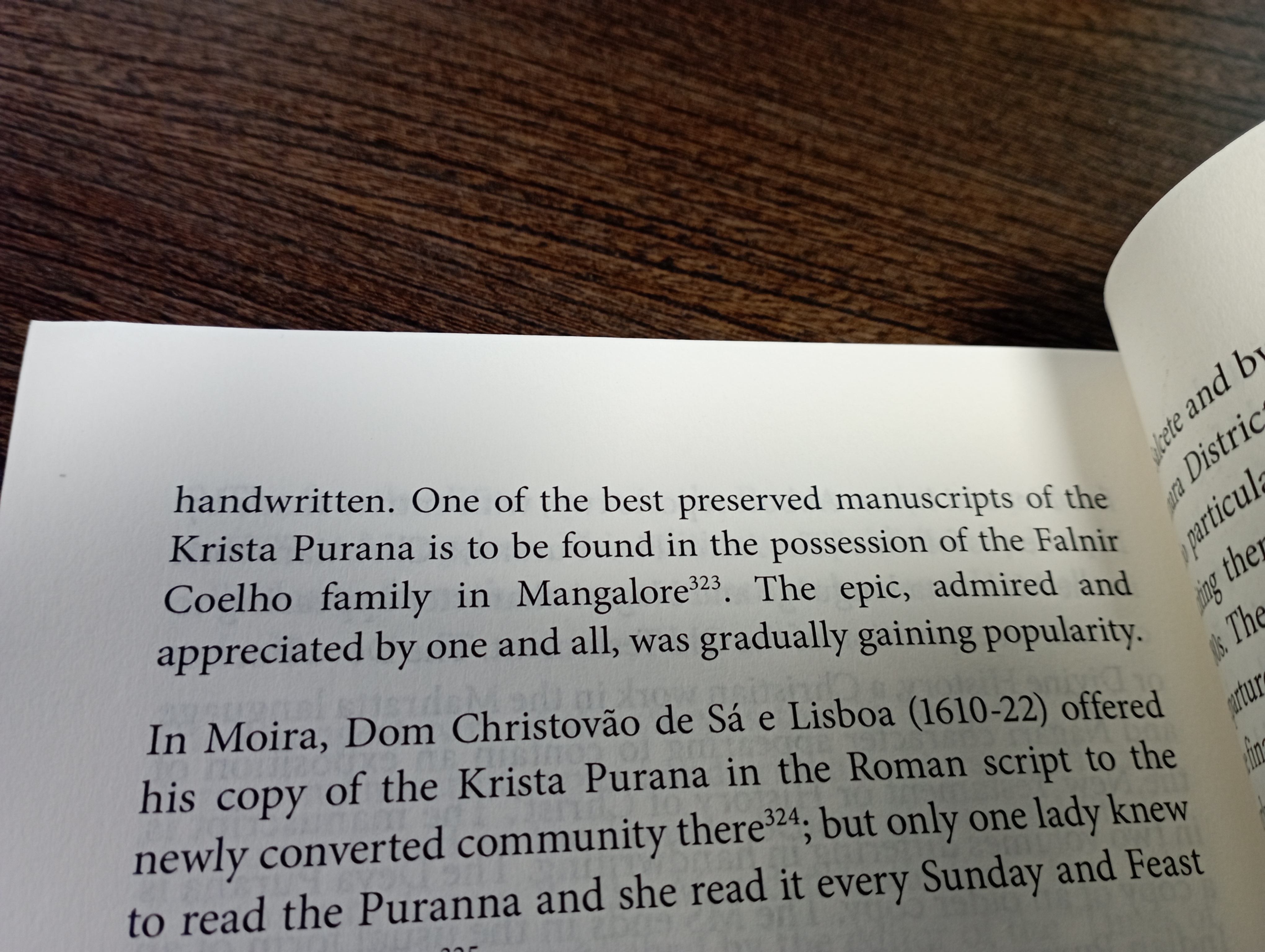
And this gem: "One of the best preserved manuscripts of the Krista Purana is to be found in the possession of the Falnir Coelho family in Mangalore." (178. The reference: Kranti K. Farias, The Christian Impact in South Kanara, p. 198) (Church History Association of India, 1999)
In his final chapter Velinkar takes pains to mention the Thomas Stephens Konknni Kendr, Porvorim and the Father Stephens Academy School, Vasai, but for whatever reason, he fails to mention the two massive volumes of Nelson Falcao which render the Khristapurana in current Marathi and in English, the Konkani translation by Amonkar, the studies by Tadkodkar, the republication of the Arte da Lingoa Canarim by CinnamonTeal Publications, and other such initiatives, which are, to my mind, milestones in the diffusion of the work of Stephens.
A good editor might have made this precious text even more readable, avoiding, for example, unnecessary repetitions and a certain lack of linearity in the narrative. But perhaps it is a new, circular way of narrating.
Jacob Palaparambil's defence at the UPS, Rome. Scaria Thuruthiyil, 1st reader; Bryan Lobo, SJ, 2nd reader, Mauro Mantovani, 3rd reader. President: Andrea Bozzolo.
Most of the questions were about De Smet's interpretation of Sankara and its correctness, rather than about Jacob's interpretation of De Smet.
Suggestions by Mauro Mantovani: (1) develop analogy, just as you have developed relation; (2) expand also on attributes; (3) read Gilles Emery, on q. 28 of the S.Th.
He also said Thomas spoke of two notions of person, one suitable for the human person, the other for the divine persons.
Bryan Lobo asked about person and reincarnation and moksa: without the body in moksa, is there a person or not? [But in Christian theology we have the same problem: is the separated soul a person, if person refers to the integrity of a being?]
He also asked about intuition: did De Smet speak about intuition? is there not an intuition at least in the mystical experience? that surely is not reasoning. [The Marechal tradition does not like the notion of intuition. and not Lonergan either. But one would have to examine De Smet's writings on the matter. He certainly wrote about the supreme experience.]
The following items on Thomas Stephens and the Khristapurana were kindly signalled to me by Prof. Dr. S.M. Tadkodkar on 27 March 2022:
1). Amonkar, Suresh Gundu., Christ-Puraanna, (based on the version of Christian Puraanna (originally written by Father Thomas Stephens, 1616), which was edited by Joseph L. Saldhana, 1907) into Konkani language and Edited. Published by Directorate of Art and Culture, Government of Goa, Panaji, Tiswadi, Goa, 2017, pages 1070, price Rs. 1600.00
2). Tadkodkar, S. M. "सुरेशबाब आमोणकारान केल्लें ‘ख्रिस्तपुराणा’चें कोंकणीकरण :संशोधनपर अणकाराचो आदर्श" ('Introduction') (पानांक V to XXVI), ख्रिस्तपुराण (पाद्री तोमास इश्तेव्ह,१६१६) : अणकार आनी सम्पादन, सुरेश गुण्डू आमोणकार, कला आनी संस्कृती संचालनालय, गोंय राज्य-शासन, पणजी-गोंय, २०१७, मोल रुपये एक सहस्र सशे, पानां १०७० ;
3). Tadkodkar, S. M., पाद्री तोमास इश्तेव्हंचे मराठी भाषेतील ‘क्रिस्तपुराण’, (पृष्ठांक २९१-३१४), बीजग्रंथ आणि बीजग्रंथकार, (डॉ० मधुकर रामदास जोशी गौरवग्रंथ), सम्पादक : राम आर्वीकर, श्रीमंगेश प्रकाशन, नागपूर, २०१०, पृष्ठे २४०
I have added them at the end of the "Thomas Stephens: updated bibliography" on this blog.
see also:


